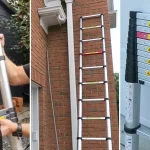
Telescopic ladders operate through a system of interlocking rungs that slide up along the rails until the desired height is reached. Each step has a self-locking mechanism that engages to hold the step in place when it is fully extended. The ladder should be placed on a flat surface, following the 1:4 positioning rule, and all locking mechanisms should be checked before climbing. To lower the ladder, the we release its controls and lower the rungs carefully. In addition, the setup and adjustment of telescopic ladders, their supported, retracted position, and maintenance for safer use will also be discussed.
Table of Contents
Key Takeaways
- Unlike most other step ladders, telescopic ones can be expanded by one step at a time, allowing the user to choose the height that they need.
- Moreover, all rungs are locked in place automatically when raising the ladder.
- A locking indicator on each side shows when a step has been properly secured and is ready to bear weight.
- To properly set up a telescopic ladder, you need to assemble it on a stable and firm surface, extending it to the desired height. Remember to follow the 1-in-4 positioning rule when leaning the ladder against a wall.
- After finishing your work, make sure to unlock the telescopic mechanism, lower the ladder, and check all of its parts for defects. Store the ladder in a dry place.
What Is a Telescopic Ladder?
A telescopic ladder is an extendable ladder, which can be folded into a portable and compact structure resembling a telescope.
Various heights of this equipment allow us to fulfill our daily tasks and work assignments more efficiently and conveniently than a classic ladder of a fixed height would, while at the same time providing easy transportation and storage due to its ability to collapse into a smaller size.
This characteristic along with the possibility to store it in a limited space makes the telescopic ladder ideal for use in small apartments in the city.
The telescopic ladder is also multifunctional and usually consists of a set of locking mechanisms designed to hold the ladder at the desired angle and height.
By choosing the EN131-6 standard, for example, we can be confident in the quality and safety of the product as it has been tested and meets all requirements.
How Does a Telescopic Ladder Extend?
To extend the ladder, we need to release a securing strap and put it on the clean and stable surface at a correct angle, typically following the 1-in-4 rule. Then, one needs to lift each step up and fix it at the desired height. The main point is that a person can use the ladder at various heights, so there is no need to extend it to the maximum height every time when it is enough to reach only a certain level.
Step Description Goal
- Release strap to prepare the ladder for extension.
- Put a ladder on a clean and stable surface at the necessary angle (1 to 4) To ensure its stability during work and extension.
- Lift every step one by one to increase the working height of the ladder.
- Choose the desired height for each step. To accomplish the goal, following the safety instructions.
While lifting the ladder, we make sure that all rungs are properly extended and secured before trying to climb up. Also, while collapsing the ladder, one should avoid getting fingers caught in the rungs by keeping hands away from the spaces between rungs. To ensure safety, a ladder should be placed on the clean and stable surface at the necessary angle.
How Do Telescopic Ladder Locks Work?
Any extension of a rung triggers its locking mechanism that ensures it is held firmly in place during use. Multiple internal locks grip the rung and hold it from sliding down when needed
Before climbing, check that each rung is visually locked as per the on-tool indicator. The visual indication of the lock is not always sufficient, so do not rely solely on its appearance
When collapsing the ladder, ergonomic release mechanisms allow the user to unlock the rungs with ease. Moreover, top-quality telescopic ladders often have a ladder closing safety mechanism that prevents uncontrolled lowering of the ladder to avoid injury
Check that all locking mechanisms are not damaged, dirty, or misaligned. If a locking mechanism does not work correctly, do not use the ladder until it is fixed.
How Do You Set Up a Telescopic Ladder?
After making sure that all locking mechanisms are in good condition, you will need to set up the ladder correctly according to the following instructions.
First of all, read the manufacturer’s guide to get familiar with all specifics of your telescopic ladder. Then, place it against the desired surface at a firm and level ground. Make sure that the base of the ladder is placed on a horizontal and clean floor.
According to the 1 in 4 rule, for every 4 feet of height, the base of the ladder should be 1 foot away from the wall
Next, extend the ladder to the desired height, one rung at a time, and lock it. Before climbing, ensure that the whole ladder structure is stable and all rungs are properly locked to prevent unexpected collapse during use.
How Do You Adjust Its Height Safely?
The safe ladder height-adjustment technique starts with a level and clean surface and having both feet on the ground. Before extending the ladder, release the strap that secures it and make sure that you do not put your hands on the rungs or other moving ladder parts.
Extend the ladder on a rung-by-rung basis, ensuring that every locking mechanism is engaged before proceeding to the next one. This way, in case of an unexpected ladder failure, you will only fall on the rung you are currently on instead of the entire ladder collapsing underneath you.
Never change the height of the ladder while standing on it: always climb down and adjust the height from the ground, making sure that the rungs are properly locked. Also, make sure that the ladder is at least 1 meter above the ground it is leaning on. Before climbing, double-check that all rungs are securely locked and avoid standing on the top 3 rungs. Following the instructions below will help you change the height of your telescopic ladder safely:
Make sure the ladder is on a firm and level ground and that you have both feet on the ground. Release the strap that holds the ladder, and extend it in a slow but steady manner, one rung at a time. Check that each rung is properly locked before moving on to the next one. Always disengage the rungs from the top of the ladder, and make sure that your hands are not on the rungs or hinges as they can quickly fall and hurt you. When the ladder is fully extended, secure it with the provided strap
When fully retracted, wrap the provided strap around the ladder. This is crucial in order to ensure that it does not accidentally extend while being transported or stored.
Which Positions Can Your Ladder Support?
Many telescopic ladders can be adjusted to multiple heights – as well as even converted into a step ladder! The majority of telescopic ladders can provide at least 2 different positions: a short ladder position and a fully extended position. Some telescopic ladders can also be converted into an A-frame step ladder, giving you an additional position to consider. Multiple-position ladders are a great choice for commercial use because they can be adjusted to multiple heights and typically have a much smaller footprint when collapsed
Check with the manufacturer to see what positions your ladder can support, as well as the locking mechanism indication for each position.
- Suitable use
- Short position Low indoor tasks
- Partial extension Windows and shelving
- Fully extended position Elevated work
A-frame position Access working on the ground
Most professional-grade telescopic ladders will allow you to use them in various positions, giving you much more flexibility and allowing you to tackle a much broader range of jobs.
How Do You Retract a Telescopic Ladder?
Before retraction, make sure the ladder is fully extended on a firm and level ground, and any straps that may secure the ladder are released. From there, make sure that all ladder sections are stable prior to collapsing it. Start from the topmost rung, and disengage the locking mechanisms to start retraction. Slowly push down on the rungs until the ladder is completely retracted.
Make sure your hands are not on any ladder rungs or hinges during the retraction process, as they may unexpectedly collapse and injure you.
Once the ladder is retracted, wrap the provided strap around the retracted ladder to ensure it stays in this position.
Once the ladder is fully retracted, wrap the provided strap around it to ensure it stays in this position.
How Do You Use and Maintain It Safely?
Using a telescopic ladder involves slowly extending it to the desired height, making sure that every locking mechanism is properly engaged before climbing. When you are ready to use the ladder, make sure to release the tool’s securing strap, inspect all of the ladder’s locks, and conduct a general inspection of the ladder. Set it up on a firm and level ground, and make sure to follow the 1 in 4 rule. Always follow the recommended procedures of the ladder manufacturer to avoid damaging it and getting injured by an improperly set up ladder. The safe usage ladder checklist is as follows:
Safety task What to do
Extending the ladder Ensure that all rungs are locked.
Inspection Check the ladder’s mechanism and locks, as well as the frame and any tools or accessories that may be attached to it.
Setting up the ladder Make sure that the ladder is set up on a firm and level ground.
Climbing the ladder Follow the 1 in 4 rule.
Maintaining the ladder Wipe and clean the ladder after using it, and make sure to store it in a dry and secure place.
After you are done with the ladder, make sure to close it according to the manufacturer’s instructions, wipe it clean, and store it in a dry and secure place. It is good practice to perform a ladder inspection before and after every use to detect any potential issues before they become apparent.
Frequently Asked Questions
What materials are telescopic ladders made from?
Telescopic ladders are primarily made from light yet durable aluminum. Some ladders are made from fiberglass, and manufacturers also use plastic, rubber, and metal locks to highlight all the safety and comfort features of their telescopic ladders.
How much weight can a telescopic ladder support?
You can expect most telescopic ladders to support anywhere between 250 – 330 pounds, depending on their build and material. Always check the manufacturer’s specifications before climbing the ladder, and remember to factor in the weight of your clothes, tools, and other equipment.
Are telescopic ladders suitable for professional use?
You can definitely use telescopic ladders for professional jobs. However, keep in mind that their lightweight design often sacrifices durability. Choose the ladder according to the task, inspect all locking mechanisms before every use, follow the ladder’s height and weight limitations, and make sure the ladder is certified for commercial use.
What certifications should a telescopic ladder have?
There are several important certifications that a telescopic ladder should have before you buy it. The most important ones include EN 131, ANSI-ASC A14.2, and AS/NZS 1892. Make sure the ladder has undergone third-party testing and certification, check the load capacity, and make sure all safety information, labels, and certifications are up to date.
How much do telescopic ladders generally cost?
Telescopic ladders vary significantly in price from around $80 to over $250 for some professional-grade options. If you are looking for a high-quality ladder, you may have to spend more than $300. Always consider the ladder’s intended use, certifications, weight capacity, material, and warranty when buying it.
Conclusion
By understanding how telescopic ladders extend, lock, adjust, and retract, you can maximize the potential of this handy tool. However, even the tallest telescopic ladder can only take you so far if you ignore the basic ladder safety guidelines. Make sure to set it up on firm and level ground, follow the 1 in 4 positioning rule, inspect all locking mechanisms, and keep it properly maintained. After using the ladder, make sure to close it according to the manufacturer’s instructions and store it in a dry place. By doing so, you will significantly prolong the lifespan of the ladder while keeping yourself safe at the same time.

DIY enthusiast and editor of Best Ladders.